Modular construction is growing, but moving a finished module remains a high-stakes part of the project. The Modular Building Institute’s 2024 Permanent Modular Construction Annual Report estimated that modular methods represented 6.03% of new U.S. construction in 2023. Each delivery may involve an oversized load, a narrow turn, overhead lines, or a crane waiting on site. Small planning gaps can become expensive delays.
McKinsey’s 2019 report, “Modular construction: From projects to products,” found that modular methods can shorten project schedules by 20–50% under suitable conditions. That potential depends on more than factory speed. Route surveys, load dimensions, secure restraints, weather checks, lifting plans, and coordination with qualified carriers all matter. A clear route on a screen may still hide a low branch or soft shoulder. Details matter.
This guide explains how to transport modular buildings safely, from preparation and permits to loading, transit, and unloading. It draws on recognized industry guidance and practical transport considerations, while noting that requirements vary by location and module design. No checklist replaces site-specific engineering or an experienced transport team. Even careful plans miss things. The useful question is what has not yet been checked.
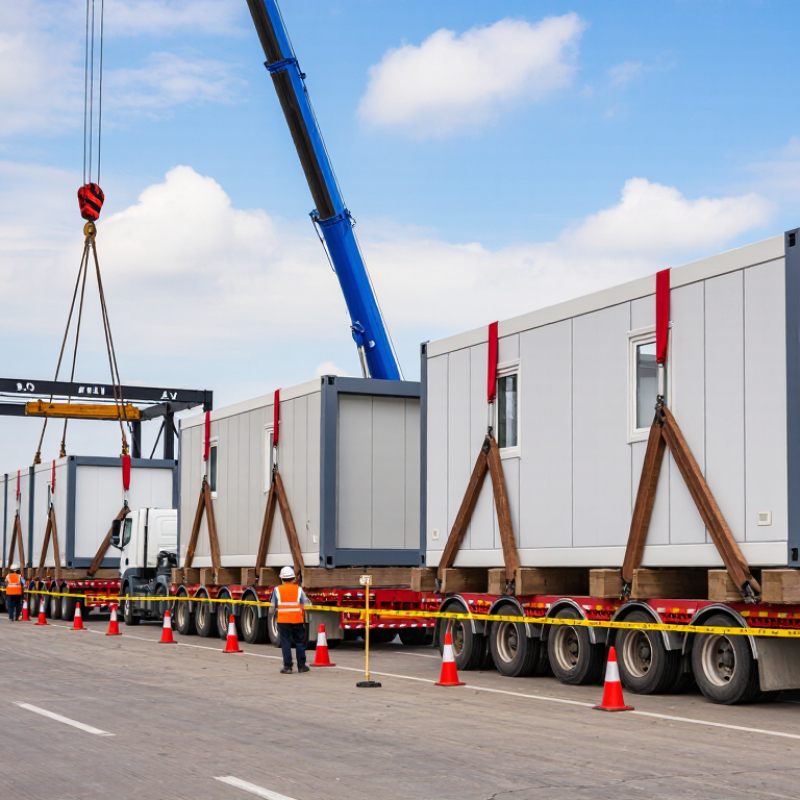
Before a modular building leaves the yard, measure its widest travel-ready point—not just the floor plan. Include exterior trim, roof edges, brackets, and any load-securing equipment that adds width. A few inches can change the route and permit requirements. Measure twice.
The Federal Highway Administration sets 102 inches as the standard maximum vehicle width on the National Network, subject to listed exceptions (23 CFR § 658.15). Treat that figure as a planning threshold, not automatic approval for every road. State and local routes may have different restrictions, and oversize permits can impose route, timing, or escort conditions. A module measuring exactly 102 inches on paper may exceed the limit once protective padding or restraints are fitted. Record the loaded width at its widest point, then confirm the planned route with the relevant transportation authorities.
For practical checks, use a calibrated tape across the exterior and note the measurement on the loading plan. Compare it with the trailer configuration, since supports and tie-downs can shift the true maximum. Then check bridge clearances, work-zone restrictions, and turning space; width compliance alone does not prove a route is suitable. FHWA’s federal dimension standard provides a reliable baseline, but it cannot replace route-specific review. This part is easy to rush. Don’t.
A modular building can look balanced on the ground and behave differently once lifted onto a trailer. Before loading, confirm the module’s verified shipping weight, including temporary bracing, fixtures, and any equipment packed inside. Then mark its center of gravity from the approved lifting plan. A shift of even a few inches can change axle loads and increase sway. Small details matter.
Match the trailer’s rated capacity and axle arrangement to both weight and balance. The Federal Highway Administration’s Federal Bridge Formula uses 20,000 pounds as a general federal benchmark for a single axle and 34,000 pounds for a tandem axle group on applicable Interstate routes. These are not universal trailer ratings or permission to haul a specific load; route rules and vehicle configurations vary. Have a qualified transport planner calculate actual axle reactions, rather than dividing module weight evenly. Uneven reactions are common.
During loading, use scales or a documented load calculation to check each axle group. Keep the module’s center of gravity within the trailer’s designed support area, and confirm that tie-down points resist movement without crushing wall panels. The Modular Building Institute’s industry guidance emphasizes planning transport and handling as part of modular project delivery. Still, plans can be wrong. Recheck after the module is secured, especially if its contents changed after weighing. Sources: FHWA, Bridge Formula Weights; Modular Building Institute, transportation and installation guidance.
Transporting a modular building safely starts long before loading. An experienced crew surveys the entire route, not just the highway. Measure building width, height, length, and transport-frame overhangs. Record power lines, signs, trees, narrow gates, and temporary roadworks. Leave real clearance, not optimistic clearance. A few centimeters can decide whether the move stops.
Turning space deserves a separate field check. A digital map may show a corner, but it cannot reveal a soft shoulder or parked vehicles. Test every roundabout, junction, and site entrance with the vehicle’s actual turning radius. Check approach and departure angles as well. Steep grades can cause frame scraping, wheel slip, or unstable braking. Confirm road surfaces and calculate safe speed changes before moving. Small errors become expensive quickly.
Bridge-load limits require written verification from qualified transport engineers and road authorities. Compare gross weight, axle spacing, axle loads, and load distribution with each bridge’s posted or engineered capacity. Do not rely on a driver’s memory. Coordinate utilities, monitor weather, and use a controlled trial route where possible. Keep a fallback route. Plans can be wrong. Recheck measurements on moving day, especially after rain, repairs, or repositioned equipment. I have seen careful plans miss one low cable, and that mistake still deserves attention.
7 Best Ways to Transport Modular Buildings Safely?
Meet FMCSA Securement Rules: Tie-Down WLL Must Equal 50% of Cargo Weight
Transporting a modular building begins with an accurate weight ticket. The FMCSA requires the aggregate Working Load Limit (WLL) of all tiedowns to equal at least 50% of the cargo weight. This is not a 50% rating for every strap. For a 40,000-pound module, the combined WLL must reach 20,000 pounds. Use certified chains, straps, or suitable combinations, and record each rating before loading.
Keep the module centered and low on the trailer. Inspect the deck for debris, damaged boards, and weak anchor points. Add blocking or friction material where movement could develop. Secure doors, windows, roof panels, and projecting components separately. Tiedowns should prevent forward, rearward, and sideways movement. Apply tension evenly. Uneven tension is easy to miss. FMCSA cargo securement guidance also requires tiedown arrangements that match the load’s size, shape, and structure.
CVSA’s 2024 International Roadcheck data recorded cargo securement as a recurring inspection violation, with 2,171 reported violations. That figure shows why a final walk-around matters. Check for loose ratchets, cut webbing, shifted blocking, and contact with sharp edges. Recheck after the first miles and at every planned stop. A common field mistake is trusting a strong tie-down attached to a weak anchor. I would still verify the actual WLL markings, because memory is not a securement method. Sources: FMCSA Cargo Securement Rules and CVSA 2024 International Roadcheck results.
Under the FMCSA general cargo securement rule, the aggregate working load limit (WLL) of the tie-downs used to secure a load must be at least 50% of the cargo’s weight. For example, a 10,000 lb load requires at least 5,000 lb of aggregate tie-down WLL. These values show the minimum aggregate WLL, not the capacity required of each individual tie-down.
Before moving a modular building, confirm its dimensions, weight, route, and delivery window. Oversize permits are route-specific, and requirements can change across state or local boundaries. Check bridge clearances, road restrictions, work zones, and turning space—not just the main highway. A permit approved for one route may not cover a detour. That detail is easy to miss.
Arrange escorts when required by the permit or route conditions. Define where escort vehicles will travel, how drivers will communicate, and who can pause the move if traffic or weather changes. The Federal Motor Carrier Safety Administration reported 5,837 large trucks involved in fatal crashes in 2022. That figure covers many kinds of trucks, not modular-building moves, but it underscores why traffic control and careful planning matter. Keep the route plan and permit documents accessible to the driver and escort team.
Loading deserves the same discipline. Use a level, stable staging area, verify lifting points against the building’s transport plan, and inspect restraints after the load settles. Photograph the secured load and record checks before departure. A small shift can matter. I have seen plans that looked complete on paper, yet left too little room for a crane or trailer alignment. Recheck the site, equipment, and weather together; no checklist can replace a final look.
Measure the module’s width, height, and length, including frame overhangs. Record cables, signs, trees, gates, and roadworks. Leave extra clearance. A few centimeters matter.
Maps cannot show soft shoulders or parked vehicles. Test each junction, roundabout, and entrance using the vehicle’s actual turning radius. Check approach and departure angles too.
Steep slopes may scrape the frame, reduce tire grip, or make braking unstable. Check the road surface and plan safe speed changes. Small errors add up.
Have qualified transport engineers and road authorities verify each bridge in writing. Compare gross weight, axle spacing, axle loads, and load distribution with its capacity. Do not guess.
The combined working load limit of all tiedowns must equal at least half the cargo weight. For a 40,000-pound module, that means 20,000 pounds total. Not per strap.
Secure doors, windows, roof panels, and projecting parts separately. Use blocking or friction material where movement may develop. Keep the module centered and low.
Check the trailer deck, anchor points, tiedown ratings, ratchets, webbing, and sharp-edge contact. Uneven tension is easy to miss. A strong strap cannot fix a weak anchor.
Recheck after the first miles and at every planned stop. Recheck route measurements on moving day, especially after rain, repairs, or equipment changes. Keep a fallback route. Plans can be wrong.
Transporting modular buildings safely starts with checking each module’s dimensions against the U.S. 102-inch network width limit and selecting a trailer with enough capacity for its weight and center of gravity. Before departure, survey the entire route for overhead and roadside clearances, tight turns, steep grades, and bridge-load restrictions. These checks help identify obstacles early and reduce the risk of damage, delays, or unsafe handling.
A clear plan for how to transport modular buildings safely also includes securing the load with tie-downs whose combined working load limit meets at least 50% of the cargo weight, as required by the relevant securement rules. Arrange any necessary oversize permits and escorts for the specific move, and use controlled loading procedures to keep the module stable from the start. Careful coordination of equipment, route, securement, and loading makes each transport more predictable and protects both the building and the people involved.

Stayvora House